
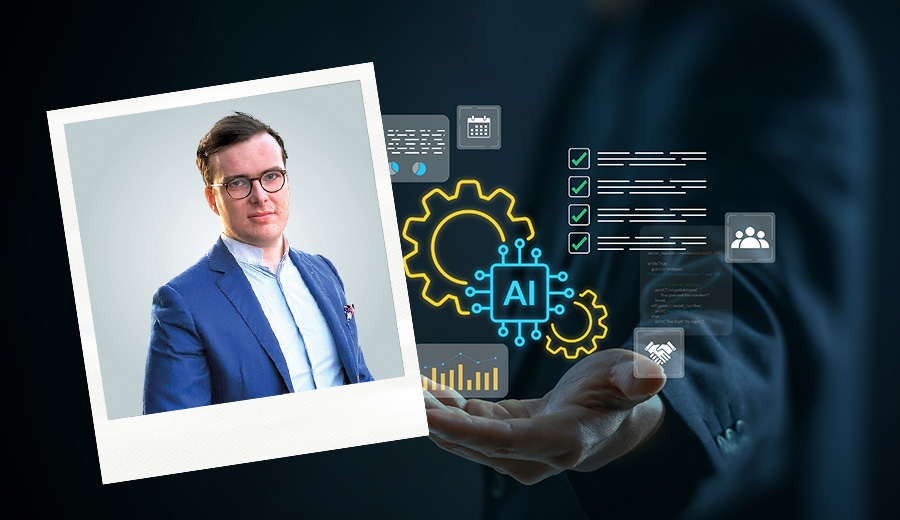
Why AI integration can deliver success to corporate IP departments
AI is transforming the way corporate IP departments manage their portfolios, but implementing new tools alone does not guarantee better results. In this article, Ambroise Diaconu, Product Manager Technology at Dennemeyer, explores why successful AI integration depends on connecting existing systems, data and workflows. He explains how combining AI-powered IP management with patent renewal information can help organizations improve productivity, gain greater portfolio visibility and turn their IP operations into a stronger driver of business value.

How AI improves productivity
Intellectual Property (IP) managers are increasingly using artificial intelligence (AI) tools throughout their day-to-day processes. This includes managing portfolios and monitoring deadlines, researching and drafting legal documents and official forms, watching and searching activities, tracking infringement, measuring results and predicting the outcome of proceedings.
The advantages of doing so are already evident and will become more so as usage and understanding increase: greater efficiency, speed and accuracy; fewer missed deadlines; smoother workflows; easier compliance management and even new commercial opportunities and revenue streams.
By taking over repetitive and routine work, AI can also free up highly skilled and experienced human resources to focus on higher-value tasks and strategic decision-making, enabling people to be innovators rather than administrators. This heightened productivity and employee engagement further contribute to overall business profitability.
According to a 2025 report by PwC and the World Economic Forum, sectors better positioned to use AI are seeing their productivity grow 4.8 times faster compared to others; meanwhile, 70 percent of CEOs expect generative AI to transform how their companies create value.
Yet, remarkably, despite investing in AI tools, many IP departments do not fully reap these benefits, either because their chosen systems are not appropriate for established workflows or because they are simply incompatible.
Overcoming barriers to integration
Given the prospects available, it is useful to reflect on the obstacles that prevent greater take-up of AI tools within IP departments.
One key barrier is the difficulty of leveraging existing data within the company's current systems and fully appreciating the potential that it offers for greater efficiency. Without unobstructed visibility into the complete portfolio, the result can be duplication of work and lost monetization opportunities.
As an example, take patent portfolio information. Most large IP departments have a sophisticated and reliable system for tracking, monitoring and handling patent renewals worldwide. This ensures the portfolio is properly managed and that no rights are lost through neglect or misunderstanding. Such solutions are now well established, highly reliable and indeed essential for many businesses.
Many of these software packages include a degree of automation and, in some cases, additional tools. But the value of the information held on renewals is not being fully realized if it is not integrated with other IP systems.
Renewals meet IP management
The best example of the value of renewals data can be seen in the connection with an IP Management System (IPMS). Leading IPMSs today provide AI-driven tools for automating workflows, managing all aspects of the portfolio from creation through to commercialization and enforcement and measuring results internally and externally.
The gains include greater precision and insight across the IP portfolio, more comprehensive reporting and a reduction in time spent on routine tasks.
However, next-generation IPMS tools are already going further, offering features such as navigation design more familiar to users of popular generative AI tools; intuitive interfaces that require little or no training; comprehensive integration with existing IT and human resources and meaningful measurement and review.
These aspects offer clear value to IP teams by making information easier to find and retrieve. They also support accountability by allowing data to be shared clearly with non-IP experts across the business, while enabling new ways of working, such as the automated allocation of tasks between staff members.
With sophisticated measurement features, AI-based IPMS tools can also track productivity gains and highlight areas for improvement. This supports internal evaluation and helps demonstrate that AI is contributing real value to the business rather than becoming another box to tick.
Harnessing the power of AI
By integrating patent renewals with their IPMS, organizations can therefore gain a clearer view of the technology and innovation landscape, reduce internal barriers and use AI more effectively to improve productivity. This, in turn, can lead to bigger returns on the investment made in protecting, acquiring and enforcing rights, a more resilient IP portfolio and the identification of new assertion and commercialization prospects.
It also means IP departments can be more efficient and more agile in responding to business developments – whether that is the development and launch of new products, competitor activity, mergers and acquisitions, funding rounds, consumer trends or legislative and regulatory change.
In IP management, the ability to respond quickly often depends on having reliable, up-to-date data at hand, which makes it worth reassessing how existing systems integrate. Reducing barriers to migration and consolidating tools can make day-to-day work easier for IP teams and support the wider business.
About Dennemeyer
The Dennemeyer Group offers high-quality services for the protection and management of Intellectual Property rights and is committed to being the first-choice partner for customers globally. With over 60 years of experience in the industry and 20+ offices worldwide, Dennemeyer manages nearly three million IP rights of around 8,000 customers.

Comments
No Comments
Write comment

Education for the best. Since 1989, executives from all areas of the company have placed their trust in the high standard of our seminars, conferences and congresses. Benefit from an optimal connection of knowledge transfer and networking.
Management Circle AG
Duesseldorfer Str. 38
65760 Eschborn
Germany
Phone: +49 6196 4722-0
Email: info@managementcircle.de